
How 3,000-Year-Old Georgian Polyphony Solved Frequency Masking
The Secret of Vocal Layering: How Three Voices Occupy the Full Audio Spectrum Without Frequency Conflict

Picture a typical studio session: you're stacking Vocal Layers, the texture is thickening, but the mix immediately muddies and loses clarity. The exhausting battle with Frequency Masking begins — endless EQ automation just to carve out space for every single voice. Now picture a system where three completely independent, complex vocal lines sound simultaneously and fill the entire audio spectrum (from Low-End to Air) in such a way that frequency conflict physically does not exist.

3000 years ago — long before computer-based multitrack recording or what we today call Stem Routing in a DAW — Georgian polyphony engineered a flawless natural audio-engineering algorithm. Beyond its monumental cultural history, this is an ancient acoustic-distribution technology that offers modern producers a fundamentally new, organic recipe for mixing.
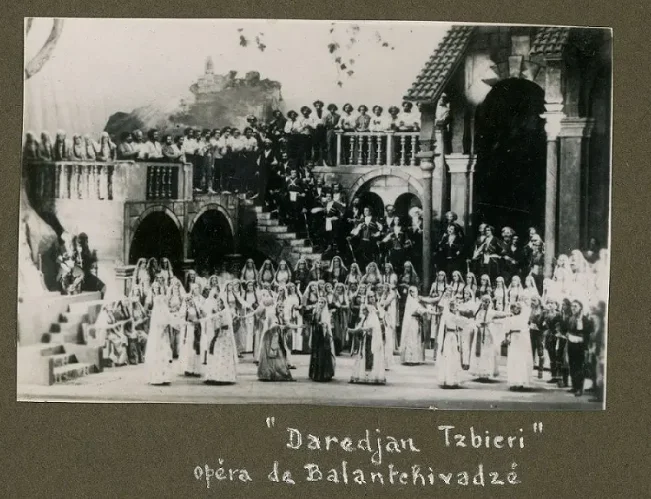
Ancient Stem Routing: How Frequencies (Hz) Are Distributed
The golden rule of modern mixing is simple: if two instruments occupy the same Frequency, they cancel each other out. Producers solve this through EQ (equalizer) — boosting one frequency, cutting another. In Georgian polyphony, this problem is solved at the physical level. Singers occupy entirely different "frequency lanes" from the very start, exactly the way we today work with different synthesizer Layering.
Here is how those 3 vocal layers distribute themselves across the audio spectrum, with no Frequency Masking required:
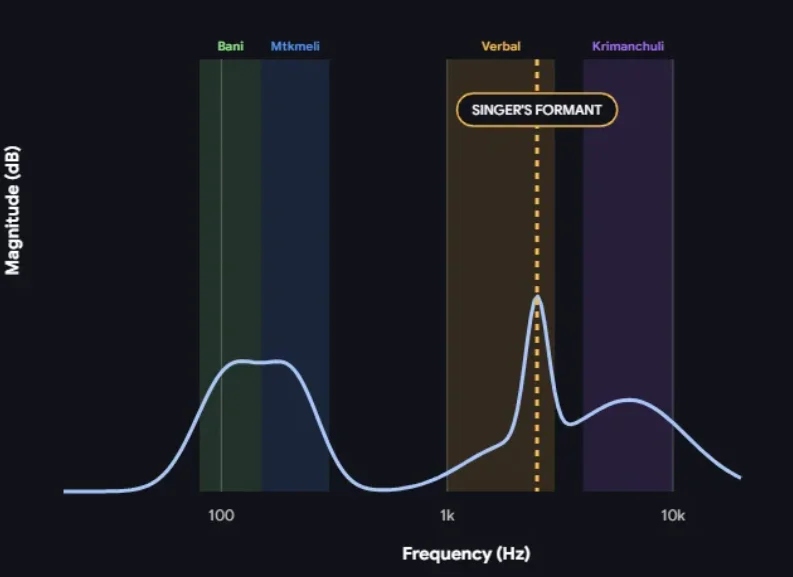
As shown in the visualization above, Georgian vocal architecture is the result of surgical-precision frequency distribution. Let's analyze this phenomenon from an audio-engineering perspective and see exactly what happens at the Hz level.
Anatomy of the Audio Spectrum: A 3-Layer Natural EQ
- Bani — The Sub-Bass Foundation (80 Hz – 150 Hz) In modern production, the "weight" of a track lives in the Low-End. In Georgian polyphony, the bani performs exactly the same function as an 808 or a synth Sub-bass. Its acoustic energy concentrates between 80 Hz and 150 Hz. It builds the foundation of the music but never climbs into the upper register, which means the Mid-range stays completely free for melody. It is the equivalent of producers no longer needing Low-Cut filters to clean up their vocals.
- Mtkmeli and the "Singer's Formant" (150 Hz – 300 Hz / Peak: 2.5 kHz) The mtkmeli carries the lead melody. Its fundamental frequency sits between 150–300 Hz, but here is where the central engineering secret of Georgian polyphony hides: to cut through the texture, singers deploy what is known as the Singer's Formant. This is an acoustic phenomenon where the vocal-tract resonances cluster into a single narrow band — roughly 2.5 kHz to 3 kHz. The human ear is evolutionarily most sensitive precisely to this range. As a result, the mtkmeli's voice — without any physical strain or overall amplitude boost (Gain boost) — Cuts through the mix perfectly. This is a natural, ultra-precise EQ boost exactly where we need it most.
- Krimanchuli — The Spectral Exciter (4 kHz – 10 kHz) Krimanchuli is a virtuosic, falsetto register positioned at the very top of the texture. Its powerful harmonics fill the 4 kHz – 10 kHz region. In modern mixing, we reach for High-Pass Filters (HPF) and Spectral Exciters to add that so-called "Air" and brilliance to a track. Krimanchuli plays exactly that role — it doesn't interfere with the lyrics of the melody; instead, it lays on top of them like a rhythmic, ultra-high-frequency ornament.
Natural Spatial Mixing
Beyond frequencies, the Georgian choir also uses natural Panning. Did you know that the traditional circular arrangement of singers is, in reality, an ancient form of Spatial Mixing?
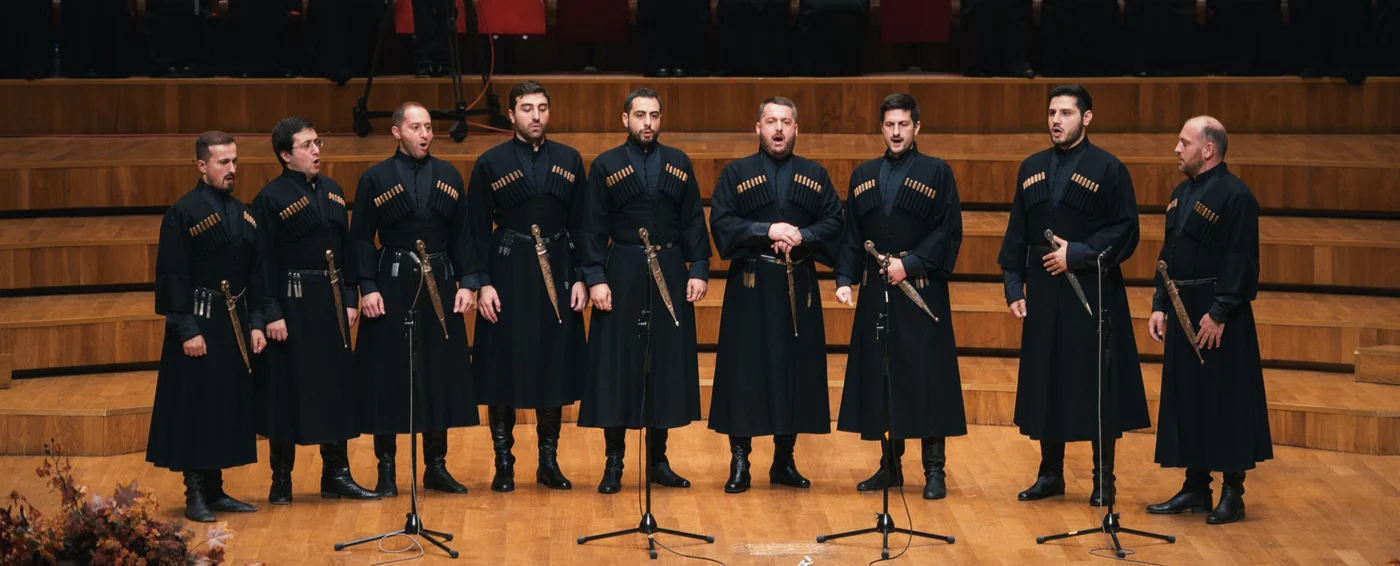
Low frequencies (bani) propagate omnidirectionally — in every direction — while high frequencies (krimanchuli) project sharply forward. By standing in a circle, the singers create a natural, multilayered Stereo width in which every voice occupies its own unique position in space.
Cinematic Tension and the "Neutral Third"
Why standard 12-TET tuning fails to create real Tension — and how Georgian microtonality changes the equation.
In modern Film Scoring, leading Hollywood composers are constantly searching for new ways to create Tension and an unresolvable, ethereal atmosphere. Yet absolutely every producer is constrained from the start by one fundamental factor: the Western 12-tone equal temperament (12-TET) baked into every DAW.
In Western music, the octave is divided into exactly 100-cent (Cents) steps. We're left with a strict duality: the Minor 3rd (300 Cents), which gives us the psychologically "sad" minor sound, and the Major 3rd (400 Cents), which gives us "happy" major. The producer is forced to choose one or the other.
Georgia's acoustic heritage destroys that duality entirely. Ethnomusicological audio analysis of the panduri and the ancient liturgical chants (specifically Malkhaz Erkvanidze's model and the data from the GVM Project) shows that Georgian harmony leans toward a 7-step equidistant temperament (7-TET), where the distance between pitches is not 100 but approximately 171 cents.
The central engineering tool of this system is what's known as the Neutral Third — sitting precisely at 350 cents.
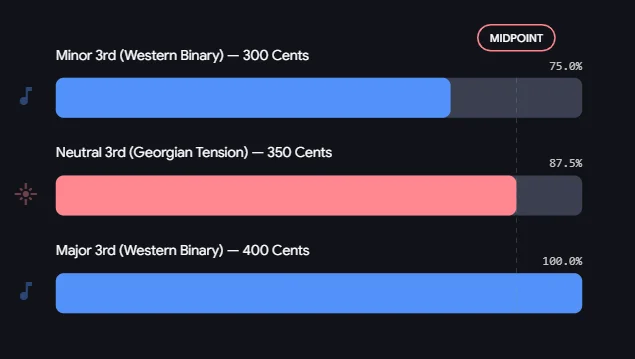
This is exactly why, within the Georgian-instrument scope of Kostava Creative's VST architecture, we build everything from day one on this ancient microtonal foundation — to put into composers' hands the cinematic weapon they have been searching for, in vain, inside the Western 12-TET ecosystem.
Acoustic Energy Escalation: Pitch Drift and Ancient Tension Building
Why pitch "drifting" upward isn't a mistake, and how acoustic Pitch automation actually works.
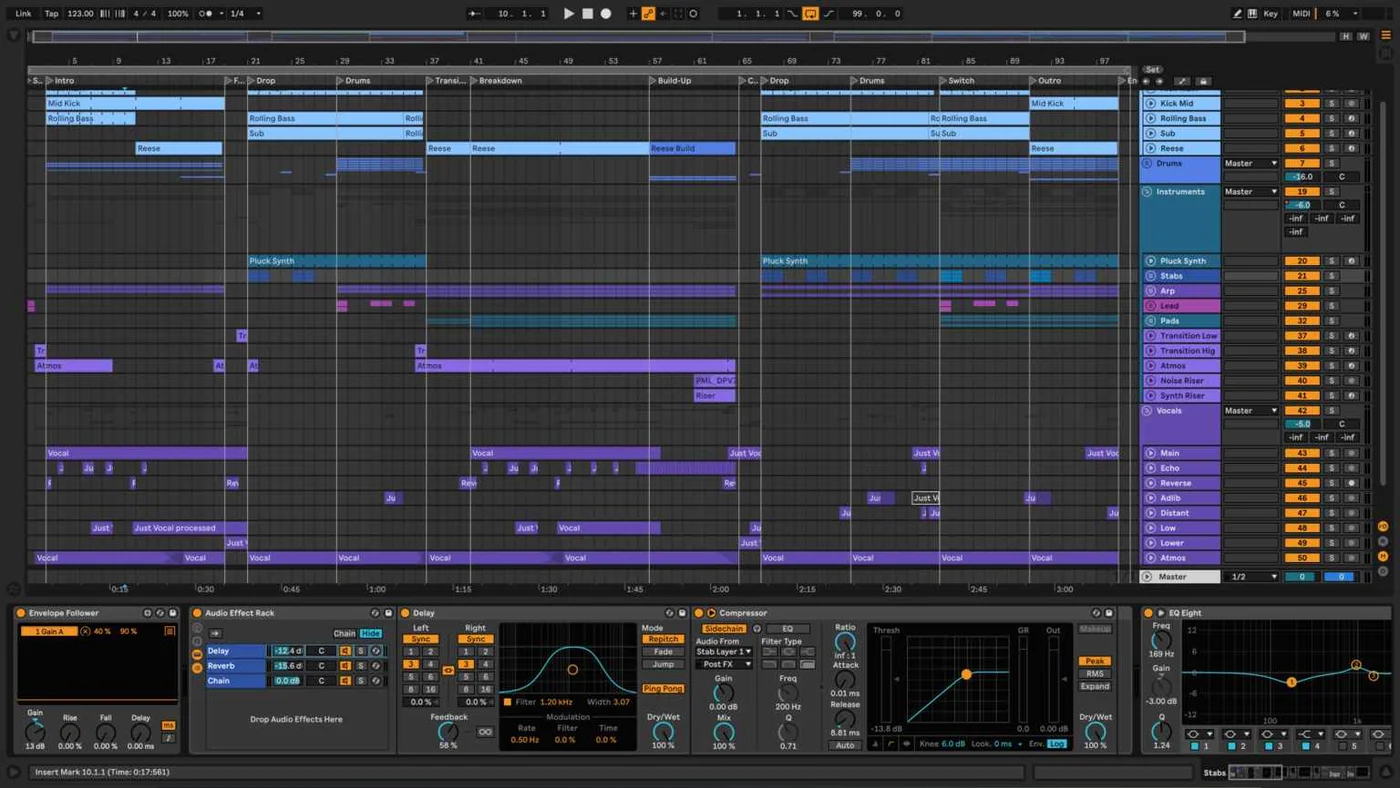
Every Electronic Music or film-music producer knows the central trick: leading into a climax — or before the so-called "Drop" — we use Pitch Riser effects on synths to grow the energy. We automate Master Pitch in the DAW so the sound rises gradually and creates kinetic Tension Building. As it turns out, this exact "automation" was already in use in the Caucasus mountains thousands of years ago.
Computational analysis of Svan songs (within the GVM Project) revealed a phenomenon that ethnomusicologists call Pitch Drift. Over the course of a song, the entire choir synchronously, smoothly, and intentionally pulls the fundamental frequency (F0) upward.
This is not mere intonational imprecision. The data shows that within a single song, the overall tonality can rise by 400 cents — that is, four semitones! Two distinct escalation algorithms have been identified:
- Slow drift: roughly 30 cents per minute (creates a hypnotic, imperceptible tension).
- Fast escalation: 100 cents per minute (deployed directly before a climax).
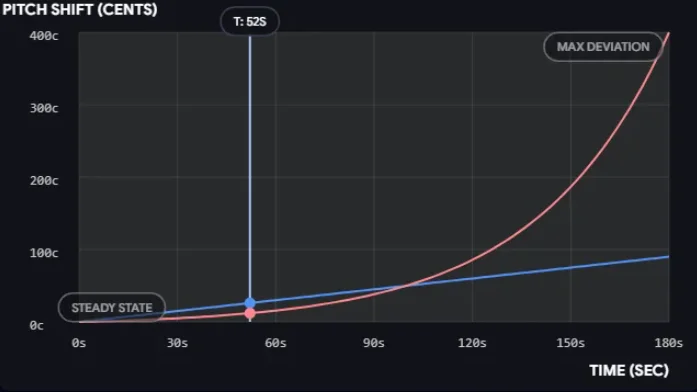
Western classical academia has often dismissed this as "intonation drift." From an Audio Engineering perspective, however, it is a natural, organic form of energy escalation. When live performers physically push the frequency upward together, the overtones stretch and a vast acoustic tension builds in the room — the kind of tension that digital Pitch-Shifter plugins still struggle to simulate convincingly.
The Final Layer of Physics — Sympathetic Resonance
Digital music has one fundamental enemy: sterility. Every virtual instrument that turns a symbolic note into sound tends to lose the physical phenomenon that makes a real instrument feel alive — Sympathetic Resonance.
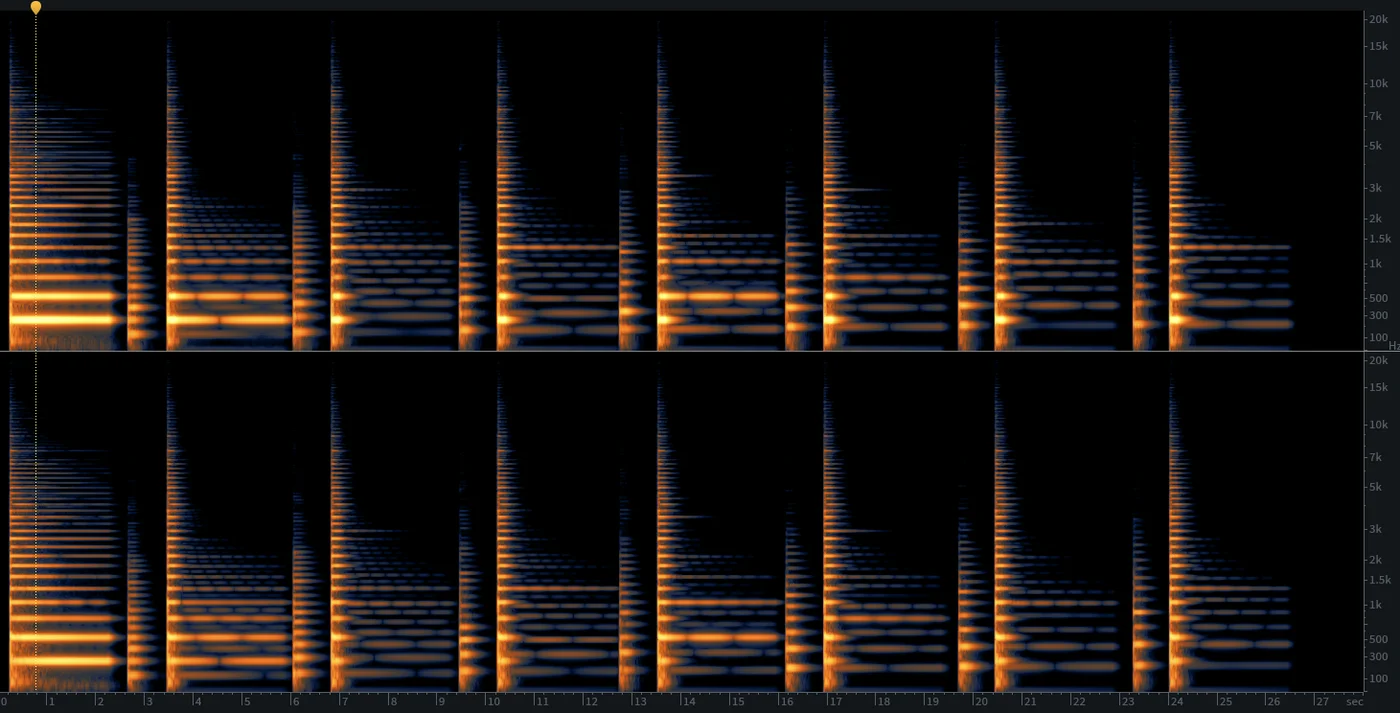
Physically: when you pluck one string of a panduri, the vibration that travels through the air and the wooden body forces the other strings to vibrate too — particularly those whose fundamentals or harmonics belong to the harmonic series of the struck note. This is the "invisible layer" that gives an instrument its three-dimensionality.
In live polyphony, the phenomenon runs even deeper. Three singers in one room are not separate mono-tracks. Their vocal vibrations meet each other physically — the bani's Low-End shakes the mtkmeli's chest cavity; krimanchuli's high harmonics amplify the bani's vocal resonance. This is a living, organic layer that Frank Scherbaum's pioneering body-vibration recordings and F0-trajectory analyses of polyphonic interaction examine in depth.
Most modern VSTs simply lack this layer — or, at best, fake it with the generic tail of a convolution reverb. In Kostava Creative's Panduri VST, Sympathetic Resonance is a foundational layer of the engine — not an effect that gets dropped at the end of the chain, but a physical model that comes alive every time a note is played.
The result: not a dry pluck, but — a living instrument in a living space.
Beyond the Grid — From Digital Simulation to a Living Ecosystem
Let's frame modern Music Production through a simple analogy: most of today's digital instruments resemble a sterile laboratory. We have 100% precise temperament (12-TET), millisecond-accurate rhythm (Quantization), and clean synthetic waveforms. But inside that perfection, the most important thing is often lost — life.
On the other side, we have Georgian polyphony and acoustic heritage from 3,000 years ago, which behaves like a living, breathing ecosystem.
For the global music industry, for Hollywood composers and electronic-music producers, this is not just another "ethnic folklore" discovery. It is a fundamental innovation and an entirely new acoustic palette. Where Western composers write convoluted chord progressions to manufacture tension, the Caucasian model tells us that full cinematic magic is hidden in a single "wrong" Neutral Third (~350 Cents) and the natural drift of overall tonality (Pitch Drift).
And buried inside this is one more secret that modern music is now circling back to:

The Power of Imperfection.
Academic research — including Frank Scherbaum's computational analyses of Georgian vocal interaction — demonstrates that the beauty of Georgian harmony lives in spontaneous, micro-rhythmic deviations and ornaments. Human voices and strings (as in the case of the panduri) respond to one another (Sympathetic Resonance) not with robotic precision, but with organic anticipation.
Hollywood Is Already Searching for the Caucasus — It Just Doesn't Know It Yet
This is not academic exotica — this is a very real frontline that leading Hollywood composers fight on every day. And what they have been trying to manufacture artificially for years already exists, naturally, in Georgian polyphony.
Hildur Guðnadóttir ("Joker," "Chernobyl") — her cello score for "Joker" won the 2020 Academy Award for Best Original Score, in part because she deliberately walked away from 12-TET precision. She uses microtonal slides and slow Pitch Drift to build tension. This is exactly the same algorithm uncovered by GVM analysis of Svan songs.
Jóhann Jóhannsson ("Arrival," "Sicario") — in "Arrival," the alien language is built on microtonal vocal textures. His use of Neutral Intervals — the foundation that gives the audience its sense of the "unrecognizable" — is precisely the phenomenon that the Georgian Neutral Third at 350 cents creates by default.
Hans Zimmer ("Dune," 2021) — Zimmer constructed for "Dune" a sacred vocal architecture that intentionally stepped outside Western harmonic logic. The female-vocal-driven, sacred quality he built — that very pursuit of vocal sacrality, where the human voice becomes the spiritual core of the music — bears a striking resemblance to a living, centuries-old Georgian tradition.
Mica Levi ("Under the Skin," "Jackie") — Levi's raw, "plainly mundane" string textures are built on the same philosophy: instead of perfection — living imperfection (Imperfection-as-instrument).
In other words: the front line of Western film music has been moving for years in exactly the direction Georgian polyphony has been holding for 3,000 years. The only difference is that the West has to reinvent this language each time. We already have it.
Three Practical Techniques You Can Use Today
- Frequency Stem-Routing for Vocal Stacking. Before you reach for EQ to "clean up" your layers, go back to the recording stage. Track three vocal layers in different registers: one with an 80–150 Hz fundamental (the bani logic), a second sitting in 150–300 Hz with a clear 2.5 kHz formant (the mtkmeli logic), and a third in falsetto with a 4 kHz+ harmonic layer (the krimanchuli logic). The result: a mix that's already in the right place before you touch EQ — natural frequency separation.
- Slow Pitch Drift Into the Drop. The standard Pitch Riser is artificial — every listener spots it within a second. Instead: across the final 60 seconds before the drop, on the master bus or a central pad, deploy a slow 30-cent Pitch Drift per minute. The ear can't isolate it consciously — but physiologically, the tension deepens. This is the foundational trick of Svan singing.
- Neutral Third (350 cents) Detuning for Cinematic Layers. Take any string library, duplicate the layer, and lock the second layer to +50 cents detuning. The result: a standard major or minor turns into a "neutral" color that belongs to no single psychological emotion. This is exactly the color Jóhannsson was reaching toward in "Arrival." It's the same color that lives, every day, inside the tertian vertical of Georgian liturgical chant.
Every one of these techniques is a missing link that Western producers assemble piece by piece, by hand. In Georgian instruments, those layers are architecturally built in.
The Kostava Creative Mission
Imagine this: you open your DAW, load up a plugin, and from the other side of the screen comes a sound the world has never quite heard the way it does today. Not as a folkloric recording. Not as ethnic entertainment. But as a full-fledged, living instrument that lives next to your mix as if it had always belonged there.
This is what Kostava Creative is building — and this is what no one has yet done with this level of completeness.

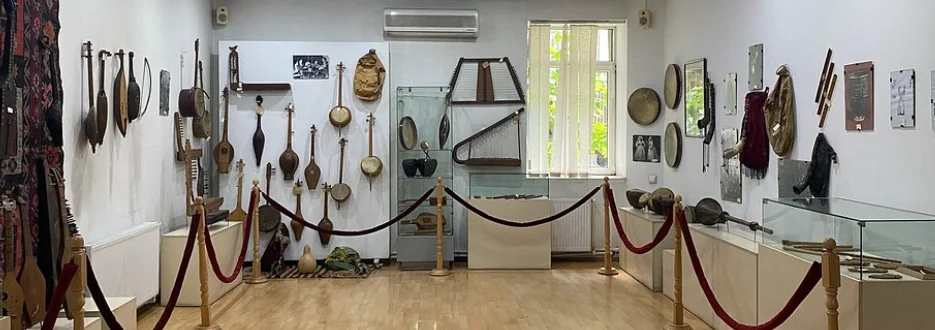
We are not making sample libraries. We are building a digital bridge between two worlds — the world where, for 3,000 years, the panduri's string lived from one mountain village to the next, and the world where, today, a Hollywood composer is searching for a sound they cannot quite find. This bridge is neither folkloric nostalgia nor digital precision "faking" the natural. It is one unified architecture, in which every microtone, every sympathetic vibration, and every natural imperfection retains its life — in digital form.
Our first instrument — Panduri — was built from the ground up on these principles. The flagship of the Georgian Sonic Dimensions collection isn't merely an ethnic instrument; it is a complete ecosystem — living resonance, living micro-timing, living microtonal layers. It doesn't try to be a Western instrument. It breaks the Grid precisely because the world of music outside the Grid is far richer than we've been led to believe.
And this is only the beginning.
Panduri. Chonguri. Chuniri. Salamuri. Doli. Duduk. Panduri's relatives from across the Caucasus. The Georgian polyphonic choir — a complete polyphonic virtual ensemble. Every voice that survived in the memory of living generations but has yet to take up residence in the world's producers' DAWs — that is our long-term mission.
Our first product — the virtual Panduri — premieres soon.
And let me underline this: it is not "another sample library." It is the first step of digital music's next vision.
Register on our platform, subscribe to our updates, and become one of the first to share in this unforgettable experience.

Sources & Research
Every academic and industry claim made in this article is grounded in leading ethnomusicological research and primary interviews with the composers cited. Below are the core sources I drew on while writing this piece:
🎓 Georgian Tuning Systems and Microtonality
- Erkvanidze, M. (2016). The Georgian Musical System. 6th International Workshop on Folk Music Analysis, Dublin. → https://arrow.tudublin.ie/cgi/viewcontent.cgi?article=1005&context=fema
- Scherbaum, F., Mzhavanadze, N., Arom, S., Rosenzweig, S., & Müller, M. (2020). Tonal Organization of the Erkomaishvili Dataset: Pitches, Scales, Melodies and Harmonies. Universitätsverlag Potsdam. → https://www.uni-potsdam.de/fileadmin/projects/soundscapelab/PapersMusic/2020/2020_Erkomaishvili_AAWM_Subm.pdf
- GVM Project — Computational Analysis of Traditional Georgian Vocal Music (Universität Potsdam & FAU Erlangen). → https://www.audiolabs-erlangen.de/fau/professor/mueller/projects/gvm
🎤 Pitch Drift and Svan Funeral / Ritual Songs
- Scherbaum, F., & Mzhavanadze, N. (2020). Svan Funeral Dirges (Zär): Musical Acoustical Analysis of a New Collection of Field Recordings. Musicologist, 4(2): 138–167. → https://dergipark.org.tr/en/pub/musicologist/article/782094
- Frank Scherbaum — Universität Potsdam, SeismoSoundScape-Lab. → https://www.uni-potsdam.de/en/soundscapelab/about-seismosoundscape-lab/people/frank-scherbaum
🔬 Singer's Formant (Acoustic Research)
- Sundberg, J. (2001). Level and center frequency of the singer's formant. Journal of Voice, 15(2): 176–186. → https://pubmed.ncbi.nlm.nih.gov/11411472/
Reader Engagement
Click or hold to clap!
Comments
Loading comments…